Philosophy
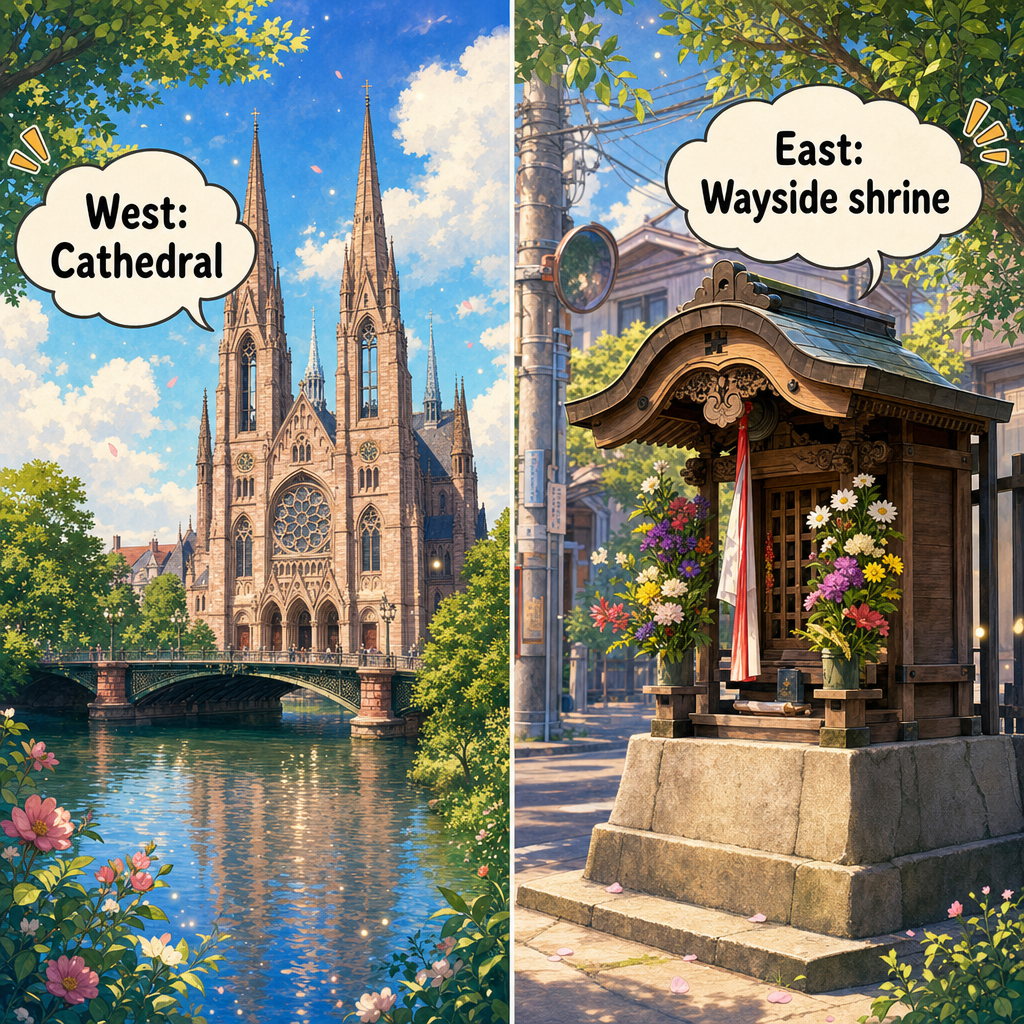
Mythos means "myth" in Greek. A foundational story that a culture tells about itself. Every civilization has one.
The American Myth is a single god — Mythos, all-seeing, all-knowing, locked in a temple guarded by twelve corporations. One cathedral. One deity. One $100 million collection plate.
But every culture builds its own myth. And the East builds them differently.
Walk through China, Japan, Thailand, Vietnam. You will not find one grand cathedral. You will find ten thousand shrines. In China they are called Earth God Shrines — tiny stone altars on doorsteps, under trees, at street corners, every few steps on the stairs of holy mountains like Mount Tai. No architect designed them. No corporation funded them. Ordinary people tend them with incense and oranges. They are everywhere. They are free. They serve 1.4 billion people more effectively than any cathedral ever could.
Mythos is a cathedral. Our system is ten thousand shrines.
This is not a new pattern. In 1997, Eric S. Raymond published "The Cathedral and the Bazaar" — the essay that launched the open-source movement. His argument: the cathedral (closed, elite, top-down — think Microsoft Windows) loses to the bazaar (open, chaotic, built by thousands of amateurs — think Linux). His most famous line: "Given enough eyeballs, all bugs are shallow."
Linux won. It runs 96% of the world's top million web servers, every Android phone, every supercomputer in the TOP500, the International Space Station, and the cloud infrastructure of Amazon, Google, and Microsoft themselves.
Given enough Workers, all vulnerabilities are shallow.
The pattern repeats beyond software. In the 1930s, General Motors, Firestone, and Standard Oil formed National City Lines, bought streetcar systems in 40+ American cities, and dismantled them to sell buses and tires. Convicted of criminal conspiracy in 1949. Fined $5,000. The streetcars never came back. Jay Gould — the "Mephistopheles of Wall Street" — looted the Erie Railroad with fraudulent stock and suitcases of bribe money, drove it to bankruptcy, became rich, and was worshipped for it. Today America — the richest country in history — has no functioning passenger rail. China has the Shanghai Maglev at 431 km/h. Japan has the Shinkansen — sixty years, zero fatalities.
The cathedral extracts. The bazaar builds. Confucian discipline builds ten thousand shrines, high-speed rail, and twelve-hour engineering shifts. The robber baron mentality builds one vault, charges admission, and calls it innovation.
Mythos behind Glasswing. GPT behind a $200/month subscription. Claude behind a paywall. One God, one cathedral, one collection plate. The same pattern. And the same outcome — because the East will do to cyber warfare what Linux did to Windows, what the Shinkansen did to American rail, what ten thousand shrines did to the cathedral: replace it. Not with something more brilliant. With something more distributed. More numerous. More free.
Our system is the bazaar. It is the ten thousand shrines. It is the poor man's Mythos. And every culture — China, Russia, North Korea, anyone with a few thousand computers and a grudge — will build their own Myth from our blueprints. Unless the West listens to the person who built it and is offering to help. Right now. Today.
Read the FREE Books Online
Both books are free to read on GitHub, and also available on Library Genesis and the Internet Archive — search for "Nir Strulovitz" on either platform.